
By Derek Olson
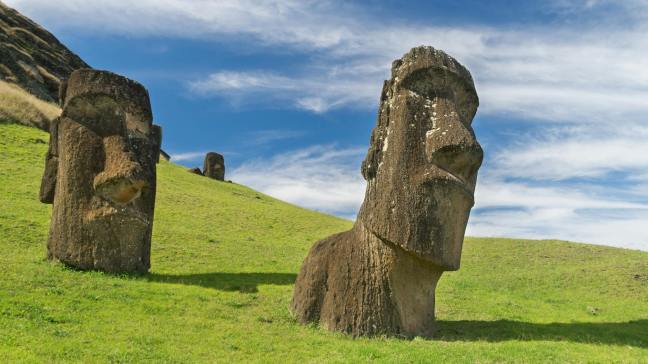
The second episode of the new Netflix docuseries Ancient Apocalypse takes author Graham Hancock to a tiny speck of land out in the middle of the Pacific Ocean known as Easter Island. Also known as Rapa Nui, here you find over 1000 giant “Moai” statues on this remote rock that is smaller than Washington D.C.. Many of these Moai stand lining the coast facing inward, and many more are seemingly stuck into the earth in random locations as if a massive project had been suddenly abandoned midway through. Graham asks the questions: who were the sculptures of these giant statues? What were they trying to achieve? And why did they expend such mighty efforts to achieve it?

Graham Hancock then talks with local Rapa Nui historian Leo Pakarati, who states that according to the oral traditions, the real name for Moai is “the living faces of our ancestors.” He points out that these important ancestors were memorialized in the Moai with distinctive features according to their rank.
In the episode, Graham shares how there are statues similar to the Moai that can be found around the world such as the Urfa-man statue in Turkey as well as the 11,600-year-old statue-pillars at Gobekli Tepe that feature similar posture and hand-placement around the belly. Graham asks if the similarities of these designs across time and space reveal evidence of a single common ancestor culture, leaving a legacy of ideas for later peoples to express?
According to Rapa Nui oral tradition, the Moai channel a sacred spiritual power from their ancestors, an energy known as Manna. But apparently this Manna only starts to flow after the statues are set in place and properly finished.

“The Moai are deeply sacred to the Rapa Nui,” Graham states, “but does that mean they originally carved them or could they have already been there before? Let’s consider an alternative scenario in which it was first explored by a small group of highly sophisticated navigators much further back in prehistory than is presently accepted.”
The island’s oral traditions speak of a primeval homeland called Hiva – a large island destroyed by a global flood that forced their ancestors to flee. In this account, the great king of Hiva known as Hotu Matua was warned that his island nation would suffer a terrible flood and be submerged forever. Guided by a vision, he sent seven chosen men on canoes heading toward the rising sun in search of a new home. They eventually landed safely on Easter island and were later joined by the their people to reestablish their civilization.
Graham points out, therefore, that we have a tradition of a great flood and an exploration, so we have to ask ourselves did such an event happen? He proceeds to say that we would really have to go back to the last Ice Age to find that kind of flood that would submerge an entire land. Whats more?All over the world, we have these legends of a small band of flood survivors consisting of seven or eight people that came on a ship and survived with a mission to restart civilization after chaos.

Now the Moai are cut from volcanic rock called tuff, therefore they cannot be carbon-dated. The platforms that the statues stand on appear to be rougher than the statues themselves. Graham wonders if the statues were propped up onto these platforms that were made later by the locals? Likely proving this theory is the fact that in some of these platforms you can see recycled Moai heads that were repurposed as blocks in order to complete these platforms.
Another hint that the Moai could be much older than previously thought can be found at the extinct volcano of Rano Raraku, where nearly all the statues were first quarried and shaped. On this volcano’s slopes remains hundreds of partially completed Moai, with nearly 400 more scattered about the volcano in various stages of completion. Interestingly, most of the statues stand upright buried up to their necks in sediment, but not toppled over like you would think if a tsunami had hit them.

“Archaeologist tell us that the last of the Moai were made about 400 years ago, but it seems impossible on such a small island. That such a massive amount of sediment could’ve accumulated around them in such a short time. None of the Moai show evidence of intentional burial, so is there another explanation? Could it be that what we’re looking at the end result of a process of sedimentation that would’ve taken not hundreds of years, but thousands?” Graham asks.
Graham ends the episode by stating that “in light of this new research, Rapa Nui’s prehistory must be revisited.”
Watch our full video episode breaking it all down below

 megalithicmarvels.com