
Just 25% down needed to save your spot/ register
I’ve had an affinity for the Maya civilization for almost 30 years, and between working with native elders, vacations, and leading tour group visits to Mexico, I can vouch for the mystical nature of these people.
Unfortunately, for over one hundred years, we’ve been fed a history of the Maya by university-sponsored archaeologists, who, (without reason) chose to ignore the living descendants of this civilization, who to this day, still practice the sacred sciences handed down by their ancestors. This disastrous practice has led to vast misinterpretations, half-truths, and theories, damaging our understanding of the Maya.
Few people realize there is an early period (The First People) or pre-Maya civilization that dates from 6000 BC and shows every indication of being significantly older. From what I have learned, it now appears the Classic Maya inherited a good deal (if not all) of their knowledge from these early people, who developed a unique, and still undeciphered, language and science.
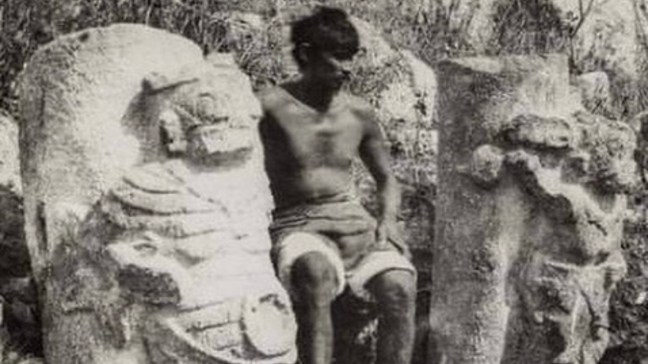
The ruins of Oxkintok (Osh-kin-took), which means “the city of the three cutting suns,” sits approximately 60 miles (66.6 km) south of Merida, the capital of Yucatan, Mexico. Located in a small courtyard just north of the city center, the fragments of a small temple with columns have been restored. An early photograph, (see below), taken at the turn of the century shows unusual columns with figures, partially exposed in sediment.
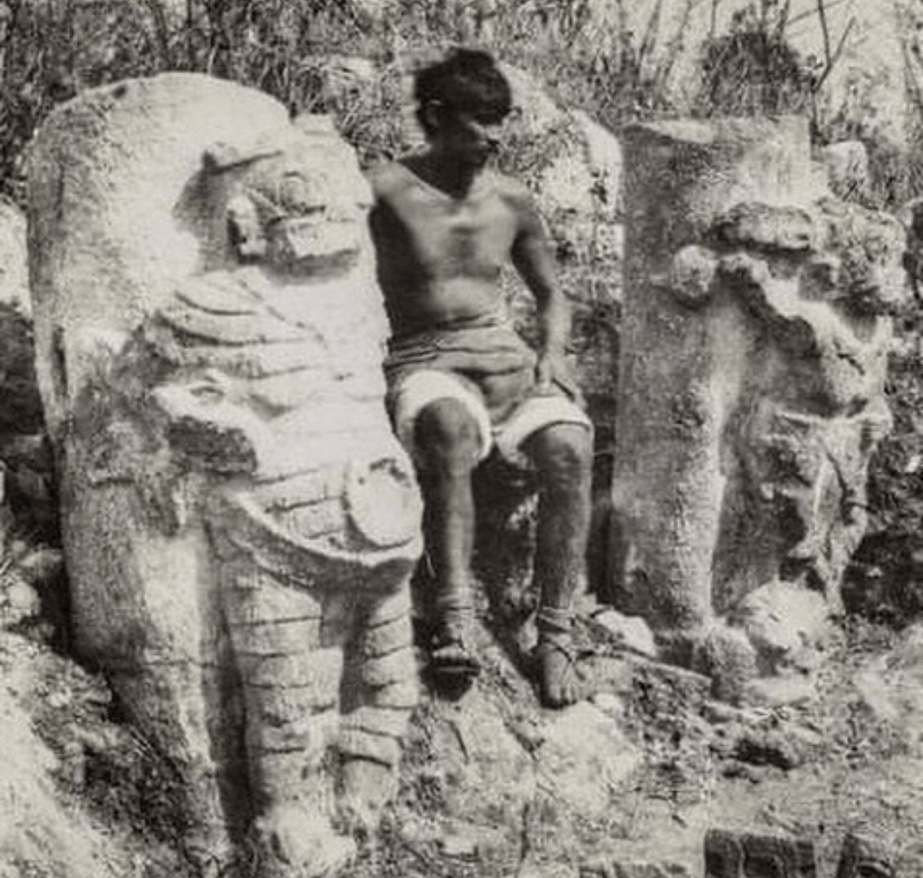
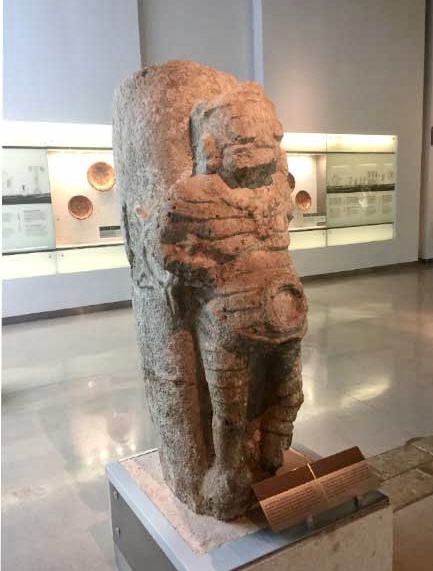
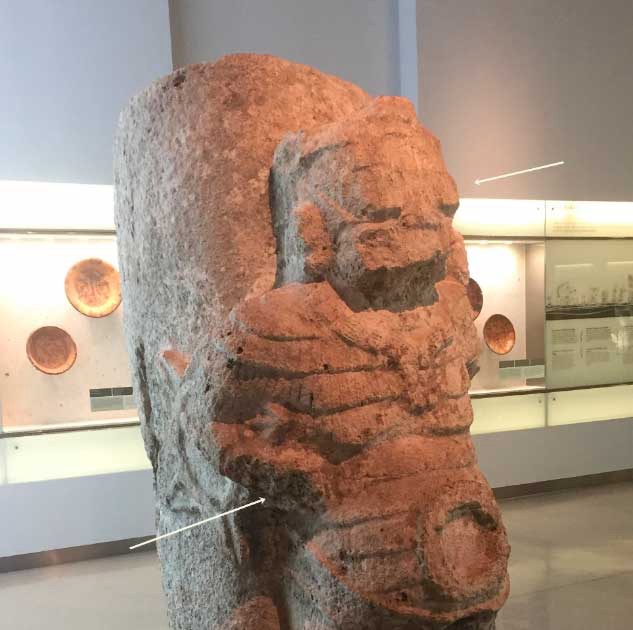
Of the two statues presented here, the large and distinctly clothed “Column 2”, has been moved to the Anthropological Museum in Mexico City, and the other, “Robot-head,” (left side) can be viewed at the Natural History Museum in Merida. Both wear armor or protective clothing and may represent soldiers, guards, or ordinary people in protective outfits.
“Robot-head” has a skull shaped like a 1950s toy robot, with a large square head, protruding rectangular eyes, extended ears, and an angular mouth. Here again, we see a pot-belly figure in full armor with a few notable differences.
A large circular shape protrudes from his mid-section and is attached to a support strap secured to the column. The right arm is bent, and the hand grasps a control connected to another star-shaped object. A large section of the raised right arm is missing, but the wrist and clenched hand are still visible.
Although several areas of the figure are poorly conceived, and portions of the face are damaged, the statue stands out as bizarre, with no other examples. Perhaps we’re looking at a figure wearing a strange protective helmet, a soldier charged with handling combustible liquids or explosives.
There are no references for Column 2 or the Robot-head statues, which leads me to wonder who they are and what historical period they represent. Unfortunately, these questions are entirely out of the context of the current historical and archaeological narratives, which appear to be struggling with the growing evidence that ancient Mesoamerican culture had a technological past.
I believe these figures and the city of Oxkintok are from a forgotten period in Earth’s history and were in ruins when the Classic Maya resettled the area a few thousand years ago. There is a good chance that Lidar scans, combined with directed ground penetrating tech, will uncover many of the unanswered questions we seek.
Sources
Adapted from this original article https://www.ancient-origins.net/artifacts-ancient-technology/stone-figure-oxkintok-0017473

 megalithicmarvels.com