
Only 25% down needed to lock in these discounts
By Derek Olson
The second season of the much anticipated and highly controversial Ancient Apocalypse docuseries has been released on Netflix featuring author Graham Hancock. This season focuses on ancient sites located in the Americas, and Graham opens episode 1 asking “Could the key to discovering a lost civilization of the ice age lie here in the Americas?”

The first half of episode 2 begins with Graham visiting Brazil’s Monte Alegre National park where a mysterious discovery lies hidden at an ancient site called Serra Do Paituna which features large rock outcroppings that rise over the jungle.
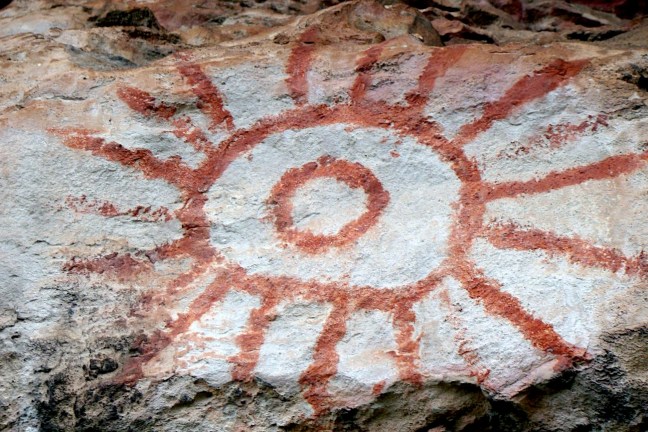
One of these rocky crags is adorned with painted images known as pictographs, that feature zoomorphic figures of snakes and animals, as well as humanoid looking faces, entities and complex geometric patterns.

According to the field archaeologist Dr. Christopher Davis, radiocarbon analysis dates these pictographs to be 12,000+ years old. This would make them some of the oldest artwork found anywhere in the Americas. Artwork created during the last ice age…
The paintings were made using red and yellow ochre and were seemingly treated to make them last forever.

Most compelling to Graham are the many handprints that can be seen. “It’s almost as though they were touching the wall, and threw the wall, touching us, sending a message to the future,” he states.
Dr. Davis said that it’s as if the ancient inhabitants were all here painting these pictographs about 12,700 years ago and then suddenly they disappeared. To which Graham replied that this 12,700 year timeline is obviously close to the Younger Dryas impact event, and wonders if this is why these ancients suddenly vanished – as temperatures plunged, fires raged and sea levels rose.

Graham shared an interesting legend from the indigenous Tiriyo people that states the following…
Long ago, the sky spirits told the shaman that a terrible flood would soon be unleashed. This was a punishment for the people’s wickedness. Some heeded his warning and fled to safety atop mount Kantani. But most perished in the flood. Eventually, the flood receded, leaving the survivors to start over.
Graham points out that it is a worldwide tradition that there was a worldwide golden age – that there was a time when humans lived in harmony with one another, but that this age somehow fell from its standards, and was punished with a great flood that resulted in a global destruction, which wiped it from the face of the earth.

The global distribution of this shared myth can’t be a coincidence according to Graham. He believes that these stories may be our last surviving memories of very real events that occurred all over the world at the end of the Ice Age.
It is interesting that one of the pictograph panels features what looks like a comet soaring alongside a sun. Graham wonders if this could possibly be a depiction of the comets that were striking the earth, eventually leading to the Younger Dryas some 13,000 some years ago
Watch our full video episode breaking it all down below

 megalithicmarvels.com