
By Derek Olson
The second season of the much anticipated and highly controversial Ancient Apocalypse documentary has been released on Netflix featuring author Graham Hancock. This season focuses on ancient sites located in the Americas, and Graham opens episode 1 asking “Could the key to discovering a lost civilization of the ice age lie here in the Americas?”
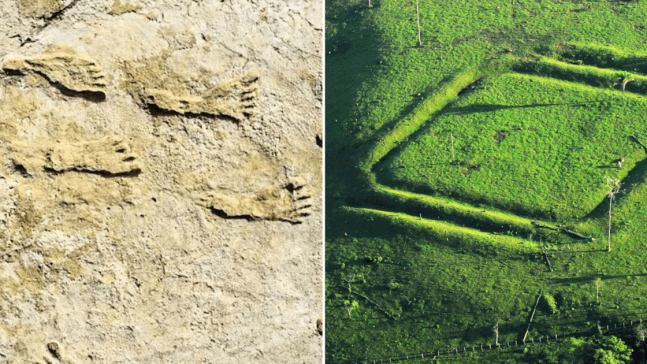
The first half of episode 1 begins with Graham visiting White Sands New Mexico where a secret hiding for thousands of years is forcing a rewrite of the prehistory of the Americas. Thousands of human foot prints imprinted alongside prehistoric mega fauna footprints – some that are estimated to be as old as 20,000+ years old.

Up until the 90s we were taught that deep in the ice age humans migrated from north Asia to Alaska across the Bearing land bridge. Then about 13,500 years ago, they walked south through an ice free corridor before spreading across the Americas. A scenario held so firmly for so long that few archaeologists went looking for traces of any earlier human migration.

In 2021, the team of scientists who found and studied the prints published their findings in the Journal of Science and then they faced severe blowback from the mainstream scientific community. Why? As Graham points out, the White Sands discovery helps to solve one of the most perplexing mysteries of prehistory – the sudden extinction of the Americas Ice Age megafauna, between 13,000 and 11,000 years ago. The suggestion of archaeology was that human beings hunted down all the megafauna and butchered them, but why would any hunter gather group willingly exterminate their food supply?
The tracks at White Sands prove that humans and those ancient animals overlapped for at least 10,000 years before the extinction. Graham states that a much better explanation for the extinction of the Ice age megafauna is a global cataclysm that took place around 12,800 years ago known as the Younger Dryas.

The Second half of the episode takes Graham to Brazil’s Amazon rain forest where 6 millions square kilometers of land lie hidden under dense canopy rainforest.
For decades, the dominant view of archaeologist was that the Amazon’s only historical inhabitants were small semi-nomadic tribes of hunter foragers. Yet, Graham believes that this dominant view is wrong.

Forest clearing has led to an amazing discovery. In 1986 a Dr. Ranzi was flying a small plane over the Brazilian rain forest when something unexpected caught his eye – giant geoglyphs as much as 1000 feet across, some of which appear to be 3-D and multi layered.
Graham asks what size of workforce could’ve made these geoglyphs and what skills were required to direct the work successfully? His answer: scientists. But what’s most fascinating of all is that they found roads connecting many of these geoglyphs… hunters and gathers do not build roads

Excavations from inside the few geoglyphs they have dug into have found 40,000+ ceramics that are highly detailed, colorful and sophisticated. These shards were dated to be 2,000 years old, and the geoglyphs were dated to be 2,500 years old – much older than the Mayans or Inca.
Graham asked the question how is it that this ancient Amazonian culture was building geoglyphs and pottery at the same time the ancient Greeks were on the other side of the world? He then wonders if both of these civilizations perhaps have shared a legacy of knowledge inherited from a vastly older civilization?

 megalithicmarvels.com